Hussein Fawaz, Jacopo Talpini, Marco Savi, Silvia Giordano, Omran Ayoub
SUPSI, Switzerland · University of Milano-Bicocca (UNIMIB), Italy
IEEE Transactions on Network and Service Management (TNSM), 2026
The problem
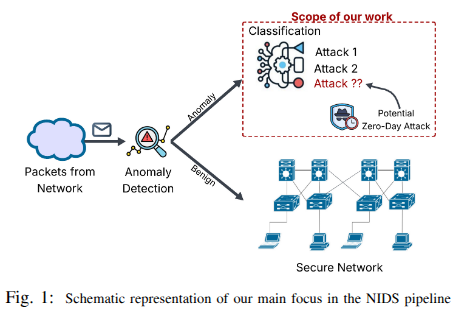
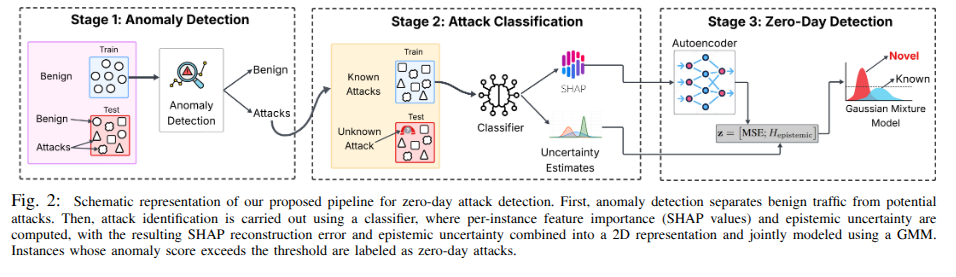
In practical Network Intrusion Detection System (NIDS) deployments, detecting an anomaly is only the first step — determining its exact nature is equally important. Anomalous traffic is commonly forwarded to a supervised multiclass classifier trained on known attack categories. This works well for known threats, but a zero-day attack is forced into one of the learned classes and ends up misclassified as a known attack. We need approaches that go beyond standard classification and can reliably recognize when an input does not conform to any learned attack pattern.
What we propose
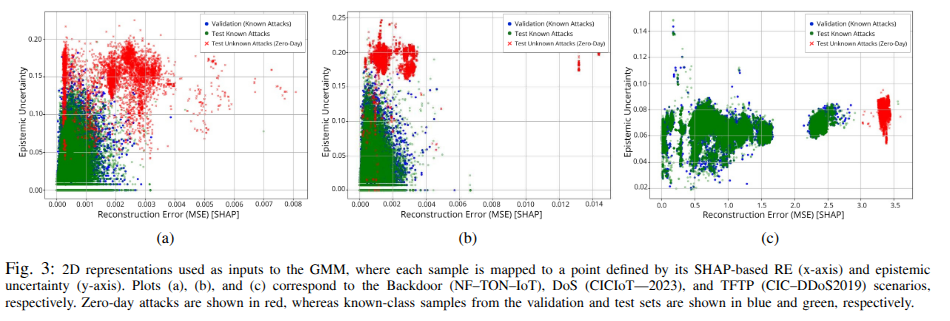
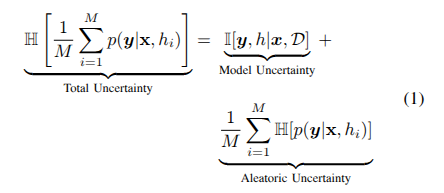
A detection strategy that jointly models two complementary signals: an explanation-driven reconstruction error, built from per-instance feature importance scores produced by an explainable AI (XAI) framework, and the predictive uncertainty of an ensemble classifier. The method is model-agnostic — we evaluate it with both XGBoost and Random Forest as the underlying classifier — using a leave-one-attack-out strategy that holds out each attack class in turn to simulate a zero-day, across three benchmark datasets: CICIoT2023, NF-ToN-IoT, and CIC-DDoS2019.
Results and takeaways
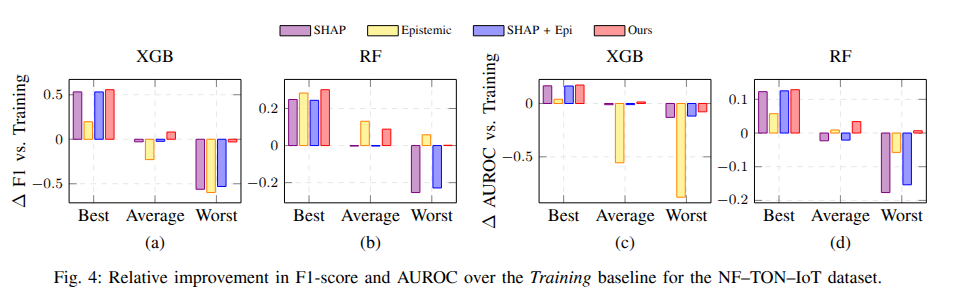
Our approach achieves best-case AUROC gains approaching 40% and F1-score improvements of up to 73%, while maintaining positive or near-neutral worst-case performance across datasets. Jointly modeling explanation-driven reconstruction error and predictive uncertainty is an effective and robust way to identify zero-day threats, making the classification stage of a NIDS more reliable in real deployments.